01
Pre-test review
Current symptoms, relevant history and factors that may affect testing are reviewed before the maneuver.
Exposure protection
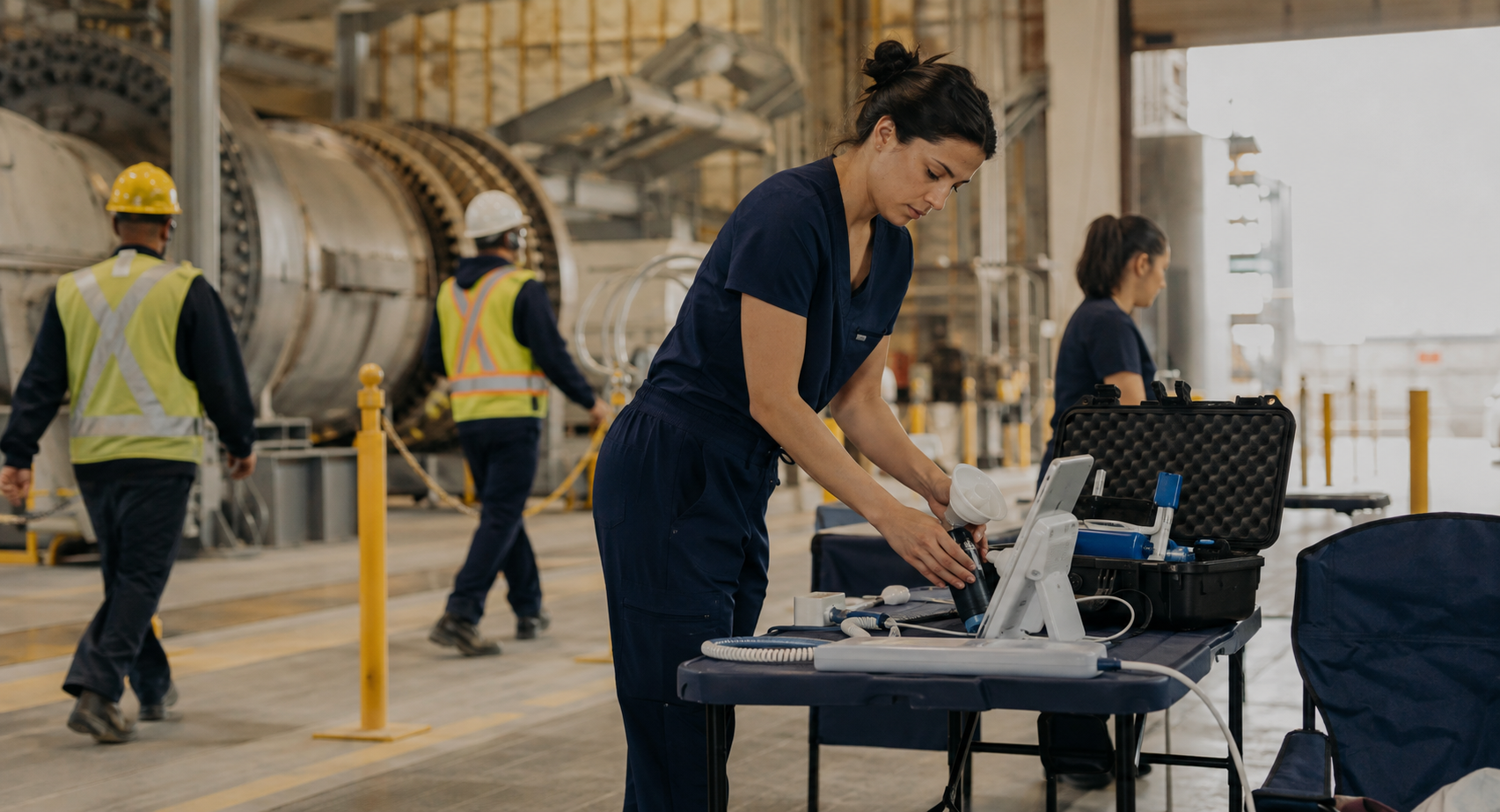
Beeline coordinates occupational spirometry with trained personnel, appropriate equipment, quality review and follow-up for employer programs.
Service overview
Spirometry measures how much and how quickly a person can move air out of the lungs. In occupational programs, accurate results depend on trained coaching, equipment verification, repeatable efforts and appropriate interpretation rather than a single unreviewed number.
What the pathway includes
The exact scope follows the selected standard, employer protocol, clinical judgment and employee-specific needs.
Current symptoms, relevant history and factors that may affect testing are reviewed before the maneuver.
The spirometer and testing environment are prepared under the selected quality protocol.
A trained technician coaches repeated efforts to obtain acceptable and repeatable results.
Results are reviewed in the context of the program, prior tests and any need for additional evaluation.
Delivery settings
Some services can travel to the workforce. Others require clinic equipment or support only remote preparation and follow-up.
On-site testing can support larger workforces when equipment, staffing and test conditions are appropriate.
Clinic testing supports individuals, repeat tests and additional clinical evaluation.
The breathing maneuvers require in-person equipment and trained coaching.
Before the appointment
Follow appointment instructions about smoking, inhaled medications, meals and strenuous activity.
Wear clothing that does not restrict deep breathing.
Tell the testing professional about current illness, recent procedures or symptoms before starting.
Appointment request
Tell us who needs care, your preferred location and a few dates that work. Beeline will follow up to confirm the appointment and any preparation steps.
Call or text (631) 899-1236Common questions
Spirometry measures the volume and flow of air exhaled after a maximal inhalation.
Yes, when trained personnel, equipment verification and a suitable environment are available.
No. Spirometry may be part of selected medical or surveillance pathways, but respirator clearance follows the OSHA medical-evaluation process.